

Rape and sexual harassment: What justice for women?

Catherine Deneuve criticised the #MeToo campaign

An account of an article by Dr Nazand Begikhani’s first published in France’s Le Monde on 23 January.

A recent statement signed by 100 French women, including Catherine Deneuve (Le Monde, 8 January) criticised the #MeToo campaign and defended the right of men to ‘importune’ in the name of ‘sexual freedom’, claiming that men have been subjected to a ‘witch-hunt’. Both the statement and Deneuve’s response (Liberation, 14 January) advocated that such cases should be left to justice institutions, away from ‘public euphoria’.

I contributed to the debate by publishing an article questioning the nature of justice for women in cases of rape and sexual harassment. Quoting Albert Camus’s famous phrase, ‘between justice and my mother, I chose my mother’, my article highlights the fact that the #MeToo campaigners, like Camus, are not opposed to justice not to men, but to patriarchal ‘violence’, if not ‘terrorism’.’

The article entitled ‘La justice est en retard vis-à-vis des femmes victimes’, refers to studies conducted by our Centre for Gender and Violence Research (CGVR), indicating that criminal justice system is short in establishing the rights of women when it comes to abuse and harassment. It adds that in certain countries, such as Iraq, the law forces raped women to marry their rapists to save the honour of their families.

In Western countries where new strategies have been adopted, it is difficult to bring abusers to justice and when it happens they are rarely condemned. Studies conducted by our Centre affirm that the criminal justice system, which is based on ‘incidence’ approach, undermines their emotional and psychological suffering of women and rarely lead to the condemnation of alleged criminals. Le Monde, via my article, highlights that this approach counters the UN Declaration on the Elimination of Violence Against Women (1993), which stipulates in its definition of Violence Against Women (VAW) all forms of ‘physical, emotional and psychological’ violence.  It reiterates that the public mobilisation and feminist campaigns can have an impact leading to justice in cases of VAW.
The article concludes that, in many places, including in Paris’ suburban zones, in refugee camps in Calais, inside migrant communities as well as in many southern and Mediterranean countries, women could not join the #MeToo campaign to denounce their abusers, fearing revenge and retribution.  It is regrettable that Deneuve’s statement, instead of helping such women in coming forward and expressing themselves, helped reactionary and extremist figures such as Berlusconi who felt he was ‘blessed’ by the statement.

The full article (in French) ‘La justice est en retard vis-à-vis des femmes victimes’ was published in Le Monde on 23 January.

More people with learning disabilities should be on TV!

My name is Beth Richards, I have a learning disability and I am an actress. I want to educate the world about people with learning disabilities through my acting, and think that mainstream TV in the UK should be doing more to represent people like me.

I am doing some research to find out why so few people with learning disabilities are on TV and what can be done to change this. At the moment data suggests that only 1.2% of people on TV have a disability (Mental Health Foundation, 2014) and we still don’t know how many of these have a learning disability.

My research is part of a much bigger ESRC funded project called “Getting Things Changed” at the Norah Fry Centre for Disability Studies, University of Bristol. This project is looking at how the barriers people with disabilities in the UK face can be overcome by changing the way people do things.

Very little research has been done to explore why so few people with learning disabilities are on mainstream TV, or in the media in general, but organisations like Mencap and The Mental Health Foundation have campaigned for things to improve. Some actors with learning disabilities have also spoken out about the issue. For example, Sarah Gordy, an actress with Down’s syndrome who has been on shows like Downton Abbey on ITV and The Silkworm on BBC 1, said:

“It’s important that people with a learning disability are seen on our screens and on stage – simply because we exist.”
(The Huffington Post, 2017).

These campaigns are starting to make a difference as both the BBC and Channel 4 have made commitments to improve the representation of disabled people on their channels. For example, the BBC has committed to quadrupling the number of disabled people in its shows by the end of this year, whilst Channel 4 launched its 360 Diversity Charter in 2015 and made 2016 it’s Year of Disability. I think these commitments are great, but it is hard to find out what impact they have had as the channels aren’t reporting their success widely. From a viewer’s perspective, it doesn’t seem like there are more disabled people, especially people with learning disabilities on TV, than there were a few years ago.

One reason why the numbers of disabled people on TV might not have increased despite the BBC and Channel 4’s commitments, might be down to the way TV is made. Shows are written, commissioned, casted and produced by different groups of people. This means there are lots of different layers where disability can be excluded or discriminated against. Many of them out of the control of the television channels themselves.

This seems to suggest that the way TV is ‘done’ affects the number of people with learning disabilities who end up on our screens. I hope to explore this issue in my research by talking to writers, commissioners, casting agents, producers and actors both with and without learning disabilities about the industry. I am going to look at what these people say using Social Practice Theory to help understand how the way TV is ‘done’ can be changed to help get more people with learning disabilities on TV.

I know people with learning disabilities can be actors and have lots of talents. We are role models for others because we know what it’s like to grow up with a learning disability.

Hopefully my research can help change the media for the better.

If you want to be involved or have anything else you could help me with my research, please contact me at beth.richards@bristol.ac.uk or my PA Victoria Mason-Angelow victoria.mason@bristol.ac.uk. You can also find out more about my research and the wider ‘Getting Things Changed’ project on our website http://www.bristol.ac.uk/sps/gettingthingschanged/

Policy makers do not need to introduce formal structures to achieve political innovation

Drawing on a case study of English Devolution in the UK, Dr Sarah Ayres, Centre for Urban and Public Policy Research, examines the role played by ‘informal governance’ in shaping political innovation.

Informal governance can be defined as a means of decision-making that is un-codified, non-institutional and where social relationships play crucial roles. Research evidence suggests that an analysis of informal governance is essential if we are to fully understand how political innovation occurs.

The issue of informality in policy-making is particularly timely as public managers seek to manage multifaceted policy problems within contested and uncertain environments. One view is that political decision-making has increasingly moved away from the national level of government to a more spatially diverse, temporal and fluid set of arrangements. From this perspective, policy-making is increasingly taking place in arenas where there is no generally accepted rules and norms according to which politics is to be conducted. Some argue that it is the surge of ‘wicked problems’ that have prompted this type of leadership, as multiple actors come together to solve complex policy problems. These developments raise important questions about how informal governance operates in this transforming policy landscape and the impact it has on political innovation. Yet, there is comparatively little research on the role of informality in policy-making, partly because of the complexity of studying it.

The case of English devolution in recent years provides us with an interesting example of the complex interrelationship between formal and informal policy making. In the case of English devolution, evidence confirms that informal governance has created an ‘innovative space’ to explore new possibilities and develop trust between critical actors. Elected politicians had a pivotal role in creating an ‘innovative space’ for senior administrators to develop new high trust relationships and working practices. Back stage, administrators were using informal governance to (re)configure institutional arrangements.

Evidence also confirms that informal governance was used to enhance the autonomy and discretion of administrators, leading to an ‘innovative oriented culture’. This shaped both the intention to be innovative and the creation of a permissive environment for change. Informal governance was used by a closely-knit group of well positioned and highly skilled boundary spanners who were motivated to use it in pursuit of securing government objectives. It was used as a tool to break deadlocks, promote political momentum and complement a weak formal bureaucracy. The ‘formalisation’ of informal working at critical points was utilised to secure political innovations that had traction.

Finally, research data confirmed that informal governance led to more responsive problem solving and a shared commitment to new policy goals. Central-local relationships were viewed as more collaborative and there was enhanced diversity and creativity in local policy outcomes. However, while informal working was viewed as a route to policy innovation, some respondents acknowledged the negative impacts regards transparency and accountability. Whitehall officials could be accused of using soft power to enforce the ‘shadow of hierarchy’ in nebulous ways, thus undermining the ability of local actors to secure real influence.

This research tells us that when formal structures and procedures are weak, political innovation can still thrive. Indeed, operating ‘back stage’ offers a number of distinct advantages for political innovation, although these must be mitigated against the pitfalls associated with increased informality if policy effectiveness is to be achieved without undermining democratic legitimacy.

This post is taken from a recent article by Dr Sarah Ayres entitled ‘Assessing the impact of informal governance on political innovation’ published in Public Management Review. This was written as part of a Special Issue on ‘Political Innovation’ and edited by Professor Eva Sorensen (Roskilde University, Denmark).

Dr Sarah Ayres has also co-edited a number of other reports on the role of ‘informal governance’ on devolution to England’s cities, including ‘Policy-making ‘front’ and ‘back’ stage: Assessing the implications for effectiveness and democracy’ and ‘Territory, Power, Statecraft: Understanding English Devolution’.

Crisis in care homes: how can we improve standards in the context of austerity?

Liz Lloyd, Professor of Social Gerontology in the Centre for Health and Social Care discusses the factors behind deteriorating standards in care homes.

There is a crisis in British care homes, arising not merely from bad behaviour by staff members but from the economic and political context of the social care market.

There are currently close to half a million individual places (‘beds’) used by around 4% of the population aged 65+ and 17% of people aged 85+. Statistics vary somewhat, according to what is being measured, but we can be certain that although the number of older people in the population have risen, a smaller proportion of them live in a care home, that they are older on average when they first enter the home and have more complex, long-term illness that require more skilled assistance.

Older people are also increasingly likely to pay at least a part of their care home fees. According to Laing and Buisson’s 2012-2013 Care of Elderly People UK Market Survey, some 43.4% of older residents in the independent sector paid the full costs and a further 14% received partial council support and topped up their fees. The majority therefore still rely wholly or partially on public resources but this proportion is falling.

Running parallel to these changes is the rise in private ownership of care homes and payment of fees. Over three decades, the proportion of places in local authority run care homes in the UK has dropped while the proportion in the private, for-profit, sector has risen so it now has a 75% share of all places. The voluntary, not-for-profit, sector share has been more stable but is falling slightly. The current crisis involves increasing levels of provider failure and exit from the care home market. Several big providers are deeply in debt, raising fears of a major collapse like that of Southern Cross in 2008. Owners point to rising costs as a consequence of the introduction of the national living wage and falling profits because fees paid by local councils have not risen in line with increased costs. The consequences for providers is an unsustainable business model.

The consequences for older people who need residential care are evident in delayed discharges and hospital waiting lists, a point illustrated perfectly in the case of Mrs Iris Sibley, who remained in the Bristol Royal Infirmary for six months while her family sought a care home place. For residents and their families the insecurity associated with provider failure means added anxiety and stress. Add to this the associated problem of worsening standards, which the Care Quality Commission fears will grow in the absence of major reform. Mrs Sibley’s son described how one place she was offered was so bad that he ‘wouldn’t put a sick dog in there’.

Not all older residents experience the same thing, of course. According to Norman Lamb MP, former Health Minister, the market has come to benefit older people with enough money to pay for their own care while disadvantaging those who rely on state support. Care homes where all or most residents pay their own fees are more secure than those that rely mostly on the local authority payments and are more able to absorb the additional cost of the national living wage. We might question why anyone would argue against a decent level of pay for the people who care for us when we are sick and disabled, but the dominant theme in social care for older people is that it should be as cheap as possible – hence, high numbers of migrant workers in the care home sector.
In fact, debates about care homes focus overwhelmingly on keeping costs down and agreeing who should pay. Should it be individuals (during their lifetime or after their deaths), their families or the public in general? Health and social care are frequently portrayed as unaffordable in the context of the ageing of the baby boomer generation.

I declare an interest here, being a baby boomer, but take issue with such a simplistic argument. Demographic trends have an impact on demand for care, for sure, but there is evidently a wider set of factors at play. Indeed it is arguable that demographic trends provide a useful rationale for cuts to public spending that would be made anyway. Policy-makers have placed themselves in a bind as cuts to public spending have impacted on private sector profits, proposals to recoup the cost of care from older people’s estates after death are met with outrage in the press, as are stories like that of Mrs Sibley.

Evidence on what makes a care home a good place to live and work is abundant. Higher standards of care are usually reflected in higher levels of staffing, more skilled workers and a culture of person-centred care that attends to the whole range of an individual’s needs, not merely to their basic physical requirements. A culture of ‘person-centred care’ promotes a sense of belonging and security and enables residents to maximise their capacities, enjoy new experiences and take risks. Care homes are likely to remain a part of the care system, despite their reputation, so we need to focus on standards. A sizeable number of us who will live in a care home at some stage of our lives, or have a close relative who does. But more importantly, care homes are inextricably linked with other parts of the care system so it is in our interests to think about standards in care homes as a policy issue that affects us all.

The Values of Assessment: It’s easier when you work in partnership

Professor Val Williams, from the Norah Fry Centre for Disability Studies at the School for Policy Studies discusses a recent project to understand people’s personal experiences of the social care assessment process.

Every day we hear about a different crisis in the NHS, some of which, at the least, can be attributed to problems in the funding of social care.

So, what happens to people who need to ‘apply’ for social care? It’s not like phoning up the doctor’s surgery and seeing your GP. To get into the social care system, you first need to have an assessment. And that assessment process will go on to determine how you will be funded, and what support may or may not be considered essential to enable you to live your life. Sounds simple? Not necessarily so. As the findings from our recent research ‘The Values of Assessment: Disabled adults and social care’ show.

The research team, led by Val Williams and Sue Porter at the Norah Fry Centre for Disability Studies, worked in partnership with members of a peer support network at the West of England Centre for Inclusive Living (WECIL), a local disabled people’s organisation, to understand their personal experience of assessments. These stories revealed the sometimes deeply felt emotions and negativity which can be created by an assessment. It can, for example, be very difficult to portray yourself as ‘needy’, to tell someone else about all the things you cannot do, rather than share the positive things you can do.

The 2014 Care Act was being implemented at the time this research was carried out, requiring social care practitioners to focus on disabled people’s own chosen outcomes in their lives, and to carry out assessments in a personalised way, so that disabled people achieve ‘wellbeing’. Everyone is different and real personalisation means recognising that fact.

All this sounds great, but the disabled people who worked with us knew that things can feel very different in practice.

The core part of this project, led by Jon Symonds, included interviews with 30 practitioners, and the messages which came from them were actually very similar to those from disabled people. In fact, the disabled researchers in the WECIL group helped to find meaning in the practitioner interviews, by listening to extracts and discussing them with the team. The theories of social care assessments might sound good, but they are often hard to achieve in practice.

‘Social workers have so many pressures on them that it is sometimes difficult for them to put the principles into practice’ said Symonds. ‘Resource Allocation Systems restricted the amount of funding available to meet a person’s needs and although many would advocate for disabled people with their managers, some would also negotiate with a person which demands were reasonable and more likely to be funded’.

The disabled people interviewed in this project said that what was most needed was ‘trust’. Practitioners also spoke about establishing a personal relationship, listening and taking time for trust to build. However, practitioners described meeting with some potential clients they felt could not be trusted:

‘Sometimes they need help but don’t want it, and sometimes they want help and don’t need it’. (Practitioner interviewed in the ‘Values of Assessment’ research).

So, there is still a need for social workers to exert ‘professional judgment’ to help some people decide what will best enable them to experience wellbeing. These are the more difficult things to discuss, and to reconcile with the views of disabled people themselves, who want control over their own lives. For truly independent living, people need support and may even need help in reaching a decision about that support. However, they also want to be part of the conversation, to speak up for themselves, and to be full partners in that assessment process. Achieving that joint interaction is much more than just ticking a box on an assessment form.

On January 19th 2017 we launched a set of videos, which were created by members of the team led by Jon Symonds, and feature the experiences of the WECIL group. These videos were designed to start the conversation between social work practitioners and disabled people who use social care. The most important thing to learn from the disabled people in these videos is that they could understand, empathise and work with the practitioners who were assessing them.

The videos from this project are now freely available, and the project team would like to hear back from anyone who has used or watched them – for training, for discussion, or just for fun. We would like to know how they’re being used, and how they could make a difference.

The ‘Values of Assessment’ videos are dedicated to Dr Sue Porter, who died suddenly on 11 January 2017, whose inspiration and leadership made this project possible. Her untimely death was a tragic loss to the disability movement, and to disability research.

International Day for the Elimination of Violence against Women

Dr Emma Williamson, Senior Research Fellow in the Centre for Gender and Violence Research, comments on why recognising the subject of violence against women has never been more relevant than it is now.

25 November marks International Day for the Elimination of Violence against Women, followed by 16 days of Activism against Gender-Based Violence.

On this day, communities reflect on the damage caused by violence against women and its impact on women, children, men, and societies around the globe.

As well as acknowledging the harm that violence against women causes, 25 November is also a day to celebrate the achievements of a movement which seeks to eradicate the gendered violence which many face every day. To recognise the men and women who work to support victims and perpetrators, to challenge abusive behaviours within societies across the world, and to stand up to the causes of violence by naming misogyny and oppression in its many forms.

At the Centre for Gender and Violence Research based at the University of Bristol, we know only too well about the experience and impact of gendered abuse. Researchers are currently engaged in projects speaking to victims and perpetrators of a wide range of abuses; collecting official data from the police and other statutory bodies; working with refugee communities to address violence against women during displacement; and working with a range of non- governmental organisation (NGO) partners to ensure that research makes a difference in the world.

So, along with our partners in the UK, Europe, and internationally, we mark 25 November as a day to recognise the achievements of a social movement which still has many uphill struggles to face.

In addition to the consistently high rates of domestic and sexual violence and other forms of gender-based violence which are experienced every year, this year in particular is a poignant year. Women’s rights have been attacked in a number of countries around the world: Poland and its attempts to restrict access to safe abortions; US presidential candidates’ “locker-room banter” about grabbing women whether they want it or not; the re-trial of a footballer on the basis of the introduction of evidence about the victim’s sexual history; and the crowning of Bono as one of Glamour magazines “women of the year”.

Okay, so the last one isn’t quite an obvious offence to women and equality – he does a lot of work about poverty and its impacts on women- but in a world where over half the population is female, it would be nice if an honour for women were given to one!

These examples show the struggles which we face to challenge the oppression which underpins gendered violence and abuse. They also show us the power of solidarity in the many acts of resistance they evoke. Polish women striking and taking to the streets against the attack on their already limited rights. Michelle Obama’s eloquent speech about the everyday reality of sexism and misogyny. Government reaction to the use of sexual history in sexual assault cases. We have yet to see how sisters uncut respond to Bono but you can be assured it will be creative and fitting!

Of course we also face an additional challenge in the UK with the recent Brexit vote to leave the European Union. The Centre for Gender and Violence Research in Bristol has a long tradition of working with European partners and we regularly meet to identify the emerging challenges which threaten the elimination of violence against women.

Whilst the terms of Brexit remain unclear, we continue to appreciate the importance and power of a global network of campaigners, researchers, and activists challenging the status quo and fighting for women’s human rights.

In Spring 2017, the Centre will be launching a new Journal of Gender-Based Violence. This is the first European- based international journal focusing specifically on this type of violence and abuse. We believe that now, more than ever, we need a space where evidence, policy, and ways of tackling gender-based violence across national borders, can be shared. It will provide a critical space in which we can continue to learn from one another and recognise the connectivity between the different challenges we face.

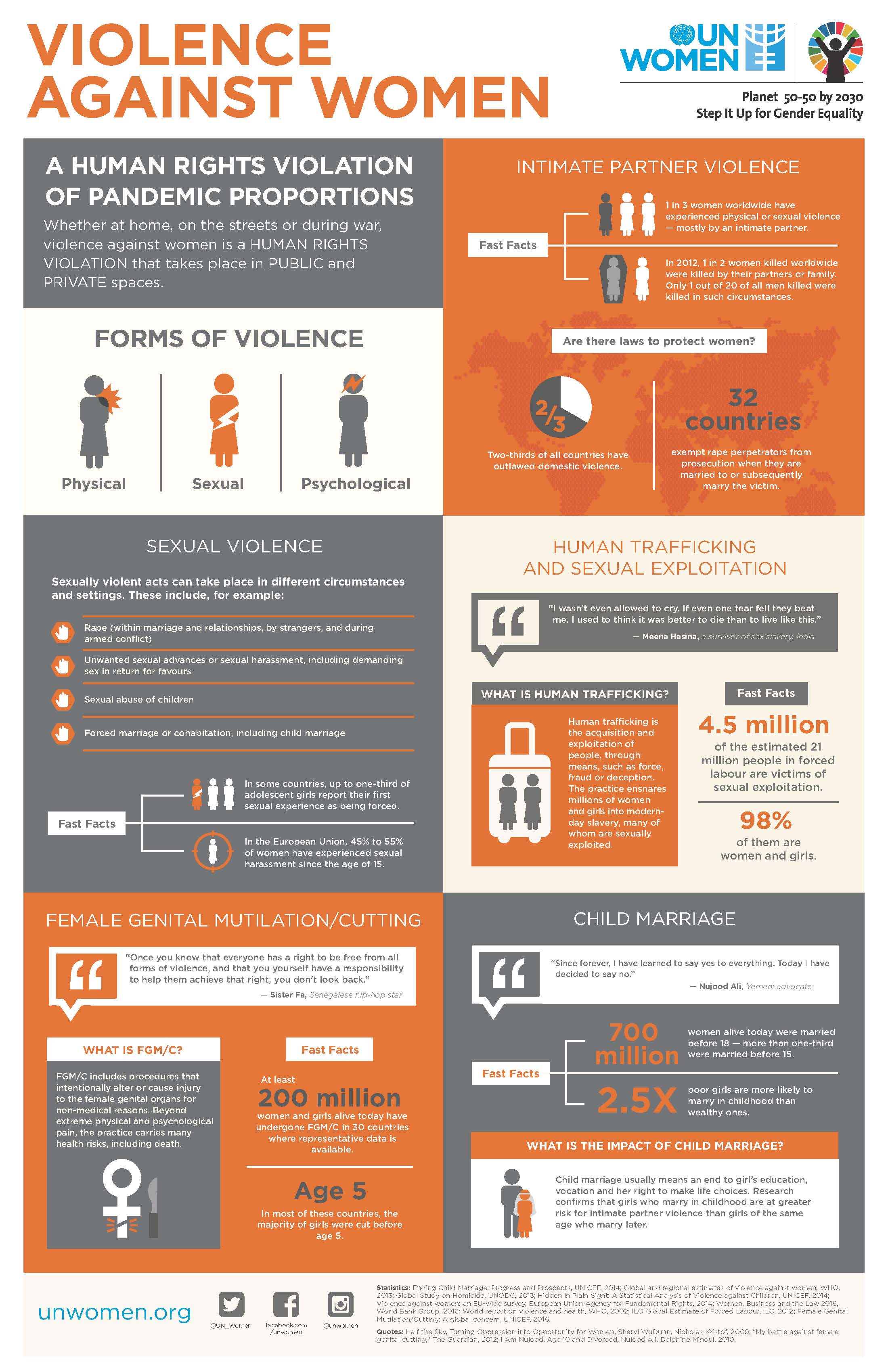
To articulate how far we still have to go, take a moment to look at the predicament of women worldwide below. (Infographic reproduced with kind permission from United Nations Women).

infographic-violence-against-women-en-11x17-no-bleeds